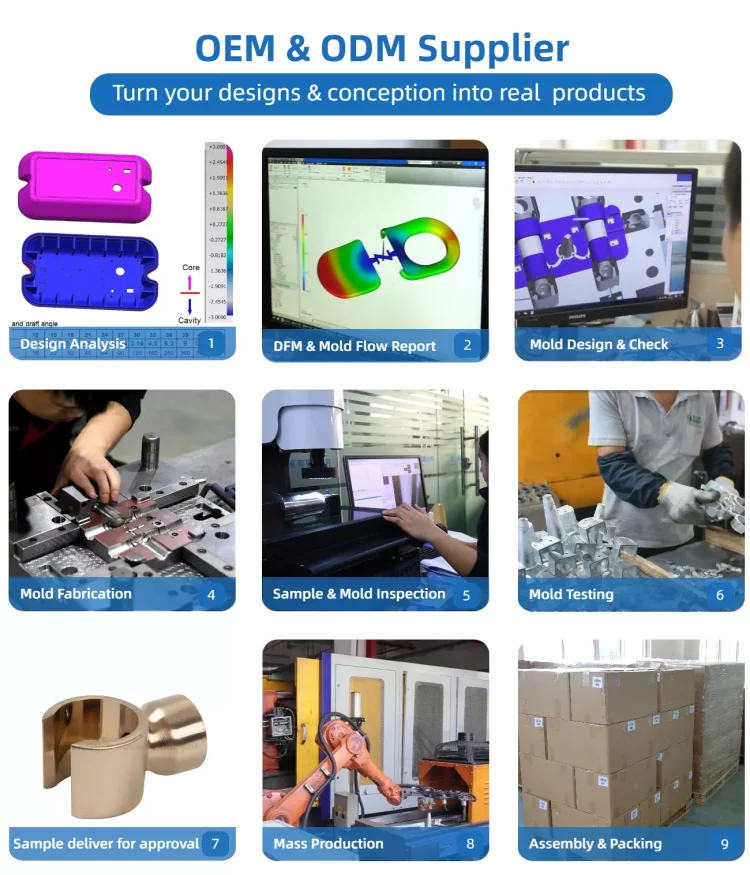
5 Critical Quality Checks for Your Custom Zinc Alloy Die Cast Parts (A Buyer‘s Guide for Lock & Security Hardware)
You’ve finalized the design for your new lock body, handle, or security component. You’ve selected zinc alloy for its exceptional strength-to-weight ratio, superior casting precision for complex mechanisms, and excellent finish for a premium feel. Now, the most crucial question remains: how do you ensure your die casting supplier delivers thousands of parts that are not only beautiful but also functionally flawless and durable?
In the lock and security hardware industry, defects are not an option. A microscopic porosity in a lock cylinder can compromise security. Dimensional variance in a handle spindle can cause jamming. Poor corrosion resistance leads to visible tarnish and failure in outdoor applications, damaging your brand’s reputation for reliability.
As a procurement manager or product engineer in the security sector, your vigilance is the final quality gate. This guide outlines the five critical quality checks you must demand for your custom zinc alloy die cast parts, with a specific focus on the rigorous demands of lock hardware, door handles, and security components.
1. Dimensional Accuracy & Stability: The Foundation of Smooth Function
Why it’s Critical for Lock Hardware: A zinc alloy lock chassis must house pins, springs, and levers with exacting tolerances. A misaligned bore or an out-of-spec latch opening can render a lock inoperable or insecure.
What to Ask Your Zinc Alloy Die Casting Supplier:
-
First Article Inspection (FAI) with CMM Data: Insist on a comprehensive report for custom lock parts or door handle components, verifying every critical interface dimension against your CAD model.
-
Statistical Process Control (SPC) for High-Volume Runs: Proof that key dimensions (e.g., spindle hole diameter, mounting hole centers) are statistically controlled throughout the production of zinc alloy security components.
-
Capability for Complex Geometries: Can they measure internal, non-visible features typical of high-security lock bodies? Inquire about their use of CT scanning or specialized CMM fixtures.
Our Capability Highlight: At [Your Company Name], we specialize in precision zinc alloy casting for lock hardware. Every project begins with a full CMM-based FAI. We implement real-time SPC monitoring on high-volume runs of zinc alloy door handles and lock cases, ensuring the consistent fit and function your assembly line and end-users demand.
2. Surface Integrity & Internal Soundness: Ensuring Strength and Security
Why it’s Critical for Lock Hardware: Surface flaws like cold shuts or, more dangerously, internal porosity in zinc casting, create weak points. For a deadbolt or latch face, this can be a point of physical attack. For thin-walled escutcheon plates, it can lead to cracking.
Key Checks to Specify:
-
Visual Inspection under Magnification: Critical for zinc alloy lock components where surface perfection impacts both security and aesthetics.
-
X-ray (Radiography) Inspection for High-Stress Parts: This is non-negotiable for custom security die casting parts like lock cylinders, strike plates, or heavy-duty handles. Request images to verify the absence of internal voids that could be exploited or cause failure.
-
Dye Penetrant Testing: An effective method to reveal surface-breaking defects on finished zinc alloy hardware before plating.
3. Mechanical & Material Conformance: The Core of Durability
Why it’s Critical for Lock Hardware: The alloy grade (e.g., Zamak 2 for higher hardness vs. Zamak 3) directly impacts a component’s resistance to drilling, cutting, and wear over thousands of cycles.
Demand These Verifications:
-
Material Certification for Specific Alloys: Ensure the supplier uses the correct, traceable alloy for your zinc die casting for locks (e.g., ZAMAK 3, ZAMAK 5).
-
Hardness Testing (Rockwell/Brinell): Verify the bulk material hardness meets your specification for durable hardware components.
-
Functional Life-Cycle Testing: For moving parts like handle levers or thumb-turns, partner with a supplier who can perform or support cycle testing to validate longevity.
4. Post-Processing & Coating Durability: Defending Against the Elements
Why it’s Critical for Lock Hardware: A lock or handle is constantly touched and exposed to weather. Inferior plating or coating leads to rapid corrosion, fingerprint staining, and a cheap appearance.
Essential Validation Tests for Finishes:
-
Adhesion Test (Cross-Cut): Critical for PVD finishes on door hardware and electroplated layers. The coating must not peel.
-
Corrosion Resistance – Salt Spray Test (ASTM B117): The definitive test for architectural hardware. Specify the required hours (e.g., 96h for interior, 240h+ for coastal exterior) for your zinc alloy die cast hardware and request the test report.
-
Abrasion & Wear Resistance Tests: Such as Taber Abrasion for frequently touched surfaces, ensuring the finish lasts.
Our Capability Highlight: Our in-house finishing department is equipped to apply and rigorously test advanced coatings specifically for architectural and security hardware. We routinely provide salt spray reports exceeding 240 hours, guaranteeing that our custom zinc alloy door hardware stands up to the harshest environments.
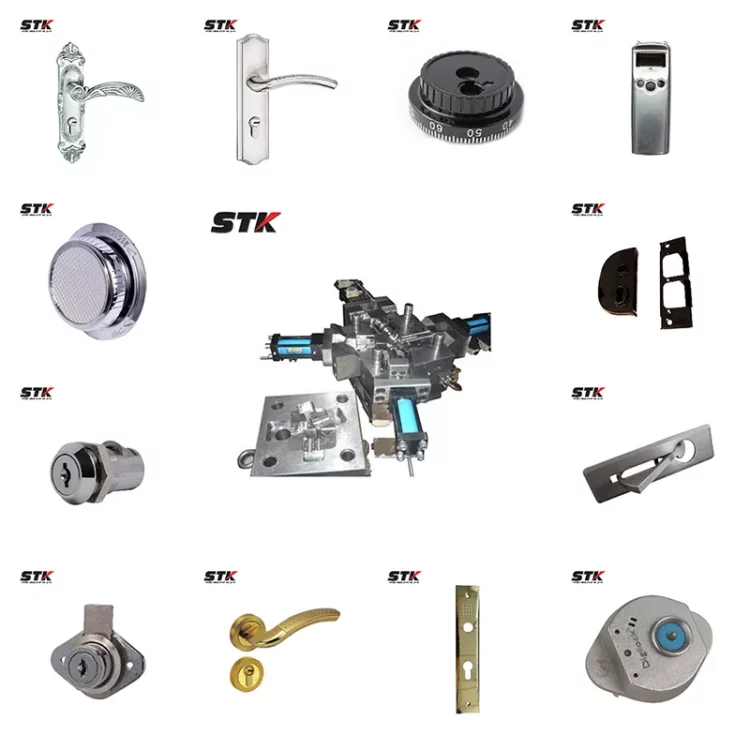
Zinc die Casting for Lock parts
5. Security Feature Integrity & Functional Testing
Why it’s Critical for Lock Hardware: Beyond basic quality, components may have unique security or functional attributes that must be preserved during casting.
Specialized Checks for Security Components:
Dimensional Integrity of Anti-Drill Plates or Hardened Inserts: Verify that features designed to defeat physical attack are cast precisely and to specification.
Magnetic Shielding Properties: If casting components for electronic locks, ensure the alloy and process do not interfere with RFID or magnetic sensors.
Pre-Assembly & Fit-Check: A competent supplier should offer to assemble sample lock sets using their cast components to verify seamless operation before full production.
Secure Your Supply Chain with Confidence
The Ultimate Proof is in the Sample
A supplier confident in their zinc alloy die casting for security applications will provide a production-intent sample, accompanied by relevant inspection data.
Don‘t compromise on security or quality. Test a supplier’s capability with your most demanding part.
Ready to partner with a die caster that understands the precision and durability required for lock hardware?
[Contact our STICK INDUSTRY engineering team today] to discuss your custom zinc alloy lock component project. Submit your drawings to receive a free DFM analysis and request a fully-inspected production sample. Let’s build security and quality into every casting.